

David Schildkret – Conductor
Robert Mills – Principal Pianist
Miriam Schildkret – messo-soprano
Zachary Golden – organist
An Afternoon of Peace
II.
Maurice Duruflé
(1902-1986)
Miriam Schildkret – mezzo-soprano
Zachary Golden – organist
Texts and Translations
CANTIQUE DE JEAN RACINE
Jean Racine (1639–1699), one of the great French dramatists of the court of Louis XIV (alongside Molière and Corneille), wrote this text as a French paraphrase of the Latin hymn Consors paterni luminis, traditionally attributed to Ambrose of Milan and sung at Tuesday Matins.
Matins, the first of the monastic daily offices, takes place in the darkness before dawn and leads directly into Lauds at daybreak. The text’s imagery—night giving way to light, silence broken by prayer—reflects this setting. The opening address, “O Word,” invokes Christ as the divine Logos, “equal of the Most High,” echoing the Gospel of John.
Gabriel Fauré composed this setting in 1865 at the age of nineteen while a student at the École Niedermeyer in Paris, where it earned him a first prize. Even in this early work, his distinctive voice is evident: long-breathed melodic lines, supple choral writing, and a gently flowing accompaniment that that seems to carry the prayer forward from darkness into light.
Verbe égal au Très-Haut, notre unique espérance,
Jour éternel de la terre et des cieux,
De la paisible nuit nous rompons le silence:
Divin Sauveur, jette sur nous les yeux.
O Word, the equal of the Most High, our sole hope,
Eternal Day of earth and heaven,
in the peaceful night, we break the silence:
Divine Savior, cast your eye upon us.
Répands sur nous le feu de Ta grâce puissante;
Que tout l’enfer fuie au son de Ta voix;
Dissipe le sommeil d’une âme languissante
Qui la conduit à l’oubli de Tes lois!
Pour out upon us the fire of your powerful grace;
may all Hell flee at the sound of your voice;
dispel the slumber of a languishing soul
that leads it to forget your laws!
Ô Christ! sois favorable à ce peuple fidèle,
Pour Te bénir maintenant rassemblé;
Reçois les chants qu’il offre à Ta gloire immortelle,
Et de Tes dons qu’il retourne comblé.
O Christ! Look with favor on this faithful people
gathered now to bless you;
receive the songs they offer to your immortal glory,
and may they return filled with your gifts.
LIKE AS THE HEART
Herbert Howells (1892–1983) stands among the leading figures of twentieth-century English music, alongside Ralph Vaughan Williams, William Walton, and Benjamin Britten. Unlike his contemporaries, he devoted much of his creative life to sacred choral music.
“Like as the hart,” composed in a single day—January 8, 1941—emerged during the London Blitz of World War II. Setting words from Psalm 42, the music gives voice to deep longing and spiritual thirst.
Widely regarded as a cornerstone of the Anglican choral repertoire, the piece unfolds with remarkable restraint and intensity. Its luminous harmonies and seamless lines convey both anguish and quiet hope.
Like as the hart desireth the waterbrooks :
so longeth my soul after thee, O God.
My soul is athirst for God, yea, even for the living God :
when shall I come to appear before the presence of God?
My tears have been my meat day and night :
while they daily say unto me, Where is now thy God?
Psalm 42:1-3
DURUFLÉ REQUIEM
Like the Howells anthem, Maurice Duruflé’s Requiem has its roots in the Second World War. Duruflé was among several composers commissioned by the Vichy regime in France in 1941 to write major works, each with a fixed fee depending on its scope. Though he was expected to produce a symphonic poem, he instead began a Requiem, still unfinished when the regime collapsed in 1944. The work was completed in 1947 and dedicated to his father, who had died two years earlier.
Closely modeled after the Requiem of Gabriel Fauré, the work is cast in nine movements. Like Fauré’s setting, it omits the terrifying Dies irae and instead includes the Libera me and In paradisum from the burial service. Most of the vocal lines are based on the plainchant melodies associated with the Requiem Mass. Duruflé weaves them into a supple, flowing musical fabric enriched by his distinctive harmonic language and brilliantly colored organ writing.
A virtuoso organist, Duruflé writes for the instrument with both brilliance and restraint, while the choral lines remain clear and luminous. The result is a work of profound consolation—offering not drama or fear, but quiet peace and hope.
Introit and Kyrie
Requiem aeternam dona eis, Domine;
et lux perpetua luceat eis.
Te decet hymnus, Deus, in Sion,
et tibi reddetur votum in Jerusalem.
Exaudi orationem meam.
ad te omnis caro veniet.
Kyrie eleison.
Christe eleison.
Kyrie eleison.
Grant them eternal rest, O Lord;
and shine perpetual light upon them.
They sing hymns to you, O God, in Zion,
and offer vows to you Jerusalem.
Hear my prayer,
for all flesh comes to you.
Lord, have mercy on us.
Christ, have mercy on us.
Lord, have mercy on us.
Offertory
Domine Jesu Christe, Rex gloriae:
libera animas omnium fidelium defunctorum de poenis inferni
et profondo lacu; libera eas de ore leonis;
ne absorbeat eas tartarus,
ne cadant in obscurum.
Sed signifer sanctus Michael
repraesentet eas in lucem sanctam.
Quam olim Abrahae promisisti et semini ejus.
Hostias et preces tibi, Domine, laudis offerimus.
Tu suscipe pro animabus illis,
quarum hodie memoriam facimus.
Fac eas, Domine, de morte transire ad vitam,
quam olim Abrahae promisisti et semini ejus.
O Lord Jesus Christ, King of Glory:
deliver the souls of all the faithful dead from the pains of hell
and from the deep pit; deliver them from the mouth of the lion;
that hell may not swallow them,
and that they may not fall into darkness.
But may the holy standard-bearer Michael
show them the holy light;
which you once promised to Abraham and his descendants.
We offer to you, O Lord, sacrifices and prayers.
Receive them on behalf of those souls
whom we commemorate today.
Grant, O Lord, that they might pass from death into that life
which you once promised to Abraham and his descendants.
Sanctus
Sanctus, sanctus, sanctus, Dominus Deus Sabaoth.
Pleni sunt coeli et terra gloria tua.
Hosanna in excelsis!
Benedictus qui venit in nomini Domini.
Hosanna in excelsis!
Holy, holy, holy, Lord God of hosts.
Heaven and earth are filled with your glory.
Hosanna in the highest!
Blessed is he that comes in the name of the Lord.
Hosanna in the highest!
Pie Jesu
Pie Jesu Domine, dona eis requiem.
Pie Jesu Domine, dona eis requiem sempiternam.
Merciful Lord Jesus, grant them rest.
Merciful Lord Jesus, grant them eternal rest.
Agnus Dei
Agnus Dei, qui tollis peccata mundi,
dona eis requiem.
Agnus Dei, qui tollis peccata mundi,
dona eis requiem sempiternam.
Lamb of God, who takes away the sins of the world,
grant them rest.
Lamb of God, who takes away the sins of the world,
grant them eternal rest.
Lux aeterna
Lux aeterna luceat eis, Domine,
cum sanctis tuis in aeternam; quia pius es.
Requiem aeternam dona eis, Domine,
et lux perpetua luceat eis,
cum sanctis tuis in aeternam; quia pius es.
Shine eternal light upon them, Lord,
with your saints forever; for you are merciful.
Grant them eternal rest, O Lord,
and shine perpetual light on them
with your saints forever; for you are merciful.
Libera me
Libera me, Domine, de morte aeterna in die illa tremenda;
quando coeli movendi sunt et terra:
dum veneris judicare saeclum per ignem.
Tremens factus sum ego et timeo, dum discussio venerit atque
ventura irae, quando coeli movendi sunt et terra.
Dies irae, dies illa calamitatis et miseriae;
dies magna et amara valde.
Requiem aeternam, dona eis, Domine,
et lux perpetua luceat eis.
Deliver me, O Lord, from eternal death on that awful day,
when the heavens and the earth shall be moved:
when you will come to judge the world by fire.
I tremble, and I fear the judgment and the wrath to come,
when the heavens and the earth shall be moved.
The day of wrath, that day of calamity and misery;
a great and bitter day, indeed.
Grant them eternal rest, O Lord,
and shine perpetual light on them.
In paradisum
In paradisum deducant te angeli
in tuo adventu suscipiant te martyres,
et perducant te in civitatem sanctam Jerusalem.
Chorus angelorum te suscipiat, et cum Lazaro
quondam pauperae aeternam habeas requiem.
May the angels lead you into paradise;
may the martyrs receive you at your arrival
and lead you to the holy city Jerusalem.
May choirs of angels receive you and with Lazarus,
who was once a pauper, may you have rest.
Special Guest Artists
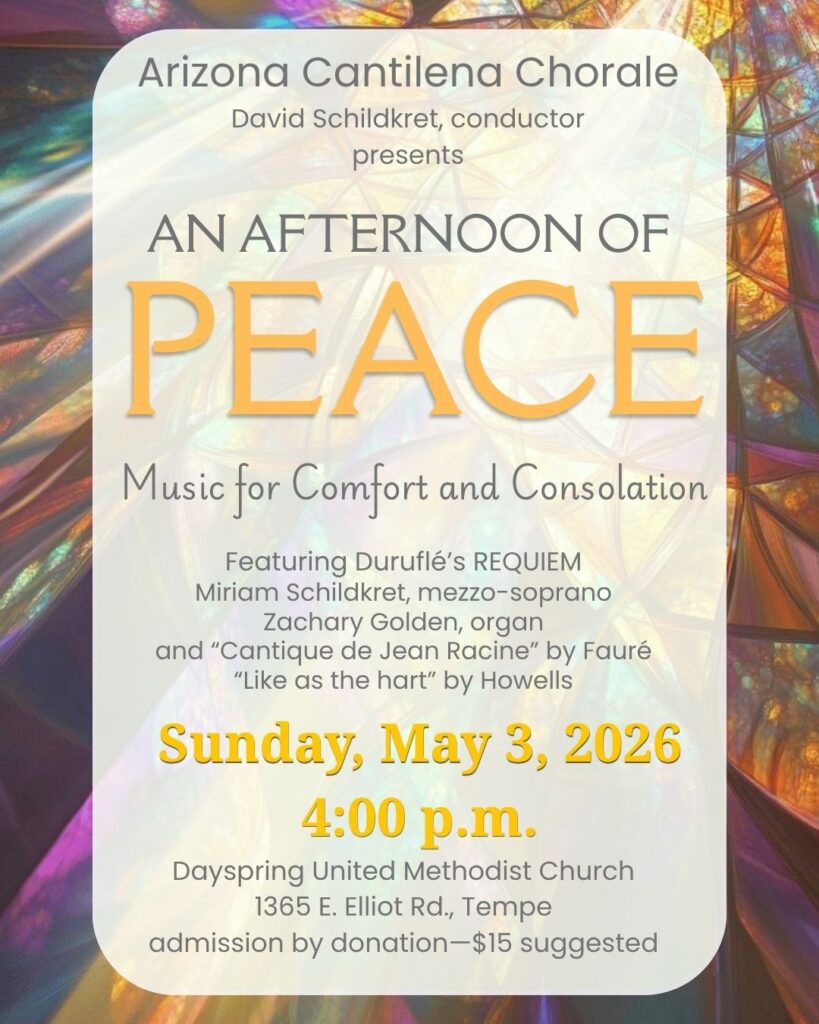
Miriam Schildkret and Zachary Golden join the Arizona Cantilena Chorale for the Duruflé-Requiem
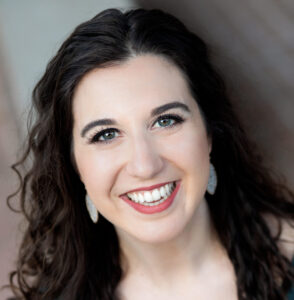
Special Guest Artist Miriam Schildkret
Miriam Schildkret, mezzo-soprano, first sang Vivaldi’s Gloria when she was 10 years old as a member of the Mount Desert Summer Chorale. She has performed the work as a soloist multiple times since then. Her most recent performance of the Gloria was as the alto soloist with the Union College Choir at Carnegie Hall in 2021. Other favorite concert appearances include Mozart’s Requiem, Haydn’s Lord Nelson Mass, Beethoven’s Mass in C, and Bernstein’s Chichester Psalms. She has sung in concerts with Arizona Opera, the Scottsdale Philharmonic, and the West Valley Chorale. Miriam’s operatic roles include Dorabella in Così fan tutte, Dido in Dido and Aeneas, and Prince Orlofsky in Die Fledermaus in addition to the numerous roles she sang during the five seasons she was an Education Teaching Artist with Arizona Opera. A proud advocate for the arts, Miriam is a frequent guest speaker for organizations across the Valley. She has been a lecturer for West Valley Arts Council, Arizona Opera, TedX Scottsdale, and was featured in the Arizona PBS series Desert Canvas.

Special Guest Artist Zachary Golden
Zachary D. Golden, a native of Pasadena, Texas, is a church musician based in Tempe, Arizona. He holds degrees from the University of Houston (BM) and Mercer University (MM, AD). His primary teachers have included Jack Mitchener and Robert Bates, both in organ. He currently serves as Organist at Dayspring United Methodist Church in Tempe.
Zachary’s musical interests center on performance practice, keyboard harmony, church music, and jazz. In addition to his work as a performer, he maintains a broad curiosity for musical styles and traditions. Outside of music, he enjoys travel and exploring coffee culture.